

Video Resolution
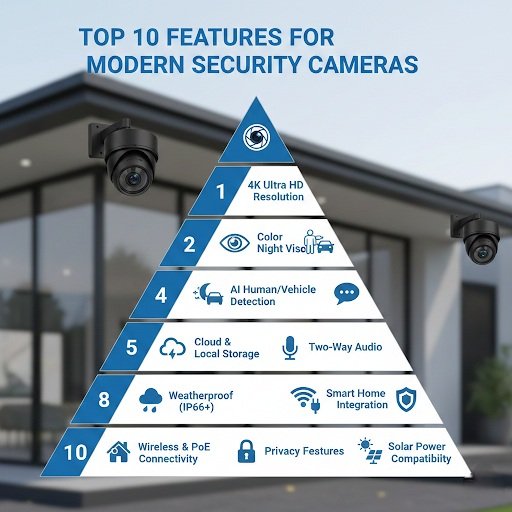
Video resolution is a critical feature to consider when selecting modern security cameras. Higher resolution translates to clearer images, which are essential for effectively monitoring and identifying individuals in various scenarios. In recent years, advancements in technology have introduced a range of resolutions for security cameras, each catering to different needs and use cases.
The most common video resolutions found in security cameras include 720p, 1080p, and 4K. The 720p resolution, also known as HD, offers a decent quality image suitable for general surveillance purposes. However, for more detailed monitoring and clearer identification of individuals, 1080p, or Full HD, is often recommended. This resolution provides a sharper image with more detail, which can be vital in situations that require quick identification.
4K resolution, also referred to as Ultra HD, has become increasingly popular among modern security cameras. Offering four times the detail of 1080p, it enables users to capture incredibly clear images that can even reveal subtle characteristics like facial features or license plate numbers. However, while 4K offers superior clarity, it also requires significantly more storage capacity and bandwidth for video streaming and recording. Thus, it is best suited for environments where high detail is paramount, such as in commercial settings or areas with high foot traffic.
Choosing the right resolution ultimately depends on the specific use case and expected level of detail. For instance, if the primary purpose is to monitor a wide area with movement detection, lower resolutions may suffice. In contrast, settings where identification is crucial may necessitate the investment in higher resolution cameras. Therefore, evaluating both your security needs and technological capabilities is essential when deciding on video resolution for your security camera system.
Night Vision Capabilities
Night vision capabilities are a critical feature to consider when selecting modern security cameras, as they greatly enhance the functionality of these devices after dark. Security incidents are often more prevalent during nighttime hours, making it essential for surveillance systems to have reliable night vision technology. This technology typically includes infrared capabilities, allowing cameras to capture clear images in total darkness without the need for visible light.
Infrared night vision functions by emitting infrared light, which is not visible to the human eye but can be detected by the camera’s sensors. This feature enables the camera to produce monochrome images that provide clear visibility in complete darkness. Most modern security cameras come equipped with a number of infrared LEDs, ensuring that even in low-light conditions, the area being monitored remains visible. This is particularly beneficial for home and business security, as it allows for continuous monitoring when criminal activity is more likely to occur.
In addition to standard infrared technology, some advanced cameras feature color night vision capabilities. These cameras utilize a combination of powerful sensors and advanced algorithms to capture full-color images in low-light conditions. This enhancement not only improves image quality significantly but also aids in identifying individuals and objects more accurately than standard monochrome images. Color night vision operates by providing the camera with a sufficient light source, whether from artificial lighting or low-light environments, thereby resulting in detailed and informative footage.
Overall, the integration of night vision technology—both in infrared and color—into security cameras is vital for comprehensive surveillance and security. By enabling effective monitoring in low-light conditions, these features can have a profound impact on the overall security of homes and businesses, ensuring that potential threats are documented and that property owners feel safe at all hours.


Motion Detection and Alerts
Motion detection technology has become a pivotal feature in modern security cameras. This functionality allows these devices to monitor specific areas for any movement, triggering alerts to the user in real-time. Such a system significantly enhances security, as it helps in promptly notifying users of suspicious activities, ensuring a swift response to potential threats.
The advantages of having motion detection in security cameras are numerous. Primarily, it alleviates the need for constant surveillance. Traditional security systems often required individuals to watch feeds continuously or review footage post-incident. In contrast, motion detection automates this process, allowing users to focus on more valuable tasks while the camera operates effectively in the background.
Additionally, many modern security cameras come equipped with customizable motion detection settings. Users can adjust parameters to specify which zones within the camera’s view should trigger alerts. This caters to various needs and environments, effectively minimizing false alarms. For instance, by ignoring movements from trees bending in the wind or pets roaming freely, security cameras can significantly reduce unnecessary notifications. As a result, users can prioritize genuine threats and avoid alarm fatigue.
Furthermore, real-time alerts are invaluable in providing immediate awareness. Many devices now feature mobile app integrations that send push notifications when motion is detected. This immediacy empowers users to act quickly, whether checking the live footage or alerting law enforcement if required, thereby enhancing personal safety and property security.
In conclusion, implementing motion detection features in security cameras is essential for a modern security setup. Not only does it streamline operations by fostering real-time alert systems, but it also contributes to an overall more secure environment, making it a fundamental aspect to consider when purchasing a security camera.
Two-Way Audio
Two-way audio is an essential feature that enhances the functionality of modern security cameras, enabling users to communicate directly through their surveillance system. This feature allows homeowners and business operators to speak with visitors or potential intruders in real-time, creating a more interactive security solution. With built-in microphones and speakers, two-way audio systems facilitate seamless voice communication, providing an additional layer of security and convenience.
For homeowners, the ability to communicate from anywhere via their smartphone or a dedicated application means that they can engage with delivery personnel, family members, or service providers without needing to physically open the door. For businesses, this feature can significantly improve customer interactions by allowing staff to assist clients remotely, answer queries, or provide support directly through the camera system. Such capabilities not only enhance customer service but also deter any suspicious behavior by making it clear that the property is under surveillance.
The relevance of two-way audio extends beyond mere convenience; it plays a critical role in enhancing home security. In potential intruder situations, being able to vocalize a warning or engage in conversation can deter unauthorized individuals. Simply speaking to an intruder can create uncertainty and heighten their sense of exposure, leading them to reconsider their actions. Thus, two-way audio serves as both a proactive security measure and a reactionary tool.
Additionally, modern security camera systems equipped with two-way audio often feature integrations with smart home technologies. This means users can set up alerts or automated responses, further increasing the system’s responsiveness. Overall, incorporating two-way audio into security camera systems significantly enhances the overall user experience and effectiveness in safeguarding homes and businesses alike.
Cloud Storage Options
In today’s digital age, cloud storage has become a pivotal feature for modern security cameras. The primary benefit of utilizing cloud storage is the ability to securely store recorded video footage offsite. This ensures that the data remains accessible, even if the physical camera is compromised or damaged. Various cloud storage options cater to different security needs, each with its advantages and disadvantages.
One of the most appealing aspects of cloud storage is its accessibility. Users can view their footage remotely from any location, provided they have internet access. This flexibility enables property owners to monitor their spaces in real-time, enhancing their security measures. However, it is essential to select a storage plan that adequately meets one’s needs. Some providers offer free basic plans with limited storage capacity, while others require a monthly subscription for more extensive features and larger storage sizes.
Moreover, it is crucial to consider the reliability of the cloud storage solution. Users should assess the provider’s reputation concerning data security and protection against breaches. In instances where footage must be accessed promptly, the speed of uploading and downloading videos is of utmost importance. A downside to cloud solutions can be the potential for latency, depending on the user’s internet connection. Thus, some individuals may prefer hybrid systems, combining local storage with cloud options, to optimize speed and reliability.
In terms of security, a robust encryption process is vital for safeguarding sensitive footage stored in the cloud. Users must ensure their chosen provider employs high-level encryption methods to prevent unauthorized access. Overall, considering reliable cloud storage options is essential for effective data security, especially for those relying on security cameras to protect their properties.
Weather Resistance and Durability
When selecting outdoor security cameras, two crucial aspects to consider are their weather resistance and overall durability. Outdoor security cameras are subject to various environmental conditions, including rain, snow, heat, and cold. A camera that can withstand the elements not only ensures functionality but also extends its lifespan, thus providing a long-term security solution.
One of the key indicators of a camera’s weather resistance is its Ingress Protection (IP) rating. This rating classifies the degree of protection a device offers against the intrusion of solid objects and moisture. For instance, a camera with an IP65 rating is fully protected against dust ingress and can withstand low-pressure water jets from any direction. In contrast, a rating of IP67 means the device can be submerged in water up to one meter for a duration of thirty minutes. Such ratings are vital when evaluating the suitability of outdoor cameras, ensuring they can reliably function in diverse weather conditions.
Additionally, the materials used in constructing security cameras also contribute to their durability. Cameras made from high-quality, weatherproof materials such as aluminum or reinforced polycarbonate tend to perform better under harsh conditions, enhancing their resilience against impact or corrosion. Furthermore, features such as a UV-resistant casing can protect the camera’s surfaces from fading and degradation caused by prolonged sun exposure.
Considering these factors when selecting outdoor security cameras is essential in ensuring optimal performance and reliability. Cameras engineered with superior weather-resistant features and durable designs are better equipped to maintain security surveillance in all environmental conditions, thus providing peace of mind for users.
Smart Home Integration
In the evolving landscape of home security, modern security cameras have become pivotal in seamlessly integrating with smart home systems. This integration not only enhances the functionality of security cameras but also elevates overall home security to new heights. One of the primary advantages of smart home integration is the ability to control your security camera remotely, allowing homeowners to monitor their premises from anywhere, at any time.
Popular smart home platforms such as Amazon Alexa and Google Home play a crucial role in this integration. For instance, many modern security cameras can be paired with these systems, allowing users to view live camera feeds or receive alerts using voice commands. This feature adds an additional layer of convenience, as individuals can simply ask their smart assistant to show them the front porch camera feed, rather than needing to access an app.
Moreover, connecting security cameras with other smart home devices, like smart lights and alarms, enhances security measures further. For example, if a camera detects motion, it can trigger smart lights to turn on, illuminating any potential intruder as well as notifying the homeowner. Furthermore, integration with smart locks can enable homeowners to unlock their doors remotely for trusted visitors while still maintaining security controls.
The ability to automate security responses is another substantial benefit of smart home integration. Homeowners can set customized prompts, such as alert notifications if unusual activity is detected. Consequently, this interconnectedness leads to a more coordinated and comprehensive security system, effectively deterring potential threats.
Ultimately, the integration of modern security cameras with smart home systems presents a multitude of advantages, providing a robust security infrastructure that adapts to the demands of contemporary living.

- Your favorite music and content – Play music, audiobooks, and podcasts from Amazon Music, Apple Music, Spotify and other…
- Alexa is happy to help – Ask Alexa for weather updates and to set hands-free timers, get answers to your questions and e…
- Keep your home comfortable – Control compatible smart home devices with your voice and routines triggered by built-in mo…
Field of View and Zoom Capabilities
The field of view (FOV) and zoom capabilities of modern security cameras are critical features that significantly enhance surveillance effectiveness. The field of view refers to the extent of the observable area that the camera can capture at any given moment. A wider field of view allows a security camera to cover more area, making it particularly useful for monitoring large spaces such as parking lots or open areas. This expansive coverage reduces the number of cameras required to achieve comprehensive monitoring and can streamline installation processes.
On the other hand, zoom capabilities enable detailed observation of distant objects or areas of interest. Cameras equipped with optical zoom lenses can magnify images without sacrificing quality, allowing users to closely inspect specific details, such as license plates or facial features from afar. This feature is especially valuable in scenarios where identification of subjects is critical, such as in law enforcement or property surveillance.
Moreover, the combination of a wide field of view and adjustable zoom can provide users with versatile surveillance options. For instance, a camera may be fixed to cover a broad area while retaining the ability to zoom into particular focal points based on suspicious activity. Many modern security cameras also offer digital zoom capabilities, although this typically results in some loss of image quality compared to optical zoom.
When selecting a security camera, it is essential to assess both the field of view and zoom functionalities in relation to the specific surveillance needs of the area being monitored. By understanding the importance of these features, users can make informed decisions and choose the right camera that provides optimal coverage and detail, enhancing overall security measures.
Installation and User-Friendly Design
When selecting modern security cameras, one critical feature to consider is the method of installation. Security cameras typically fall into two major categories: wired and wireless. Wired security cameras often provide a consistent and reliable signal, as they are physically connected to a power source and a recording device. This may lead to more stable video quality, especially in larger setups. However, their installation can be labor-intensive, requiring professional installation in many cases, which may deter some users due to potential costs and logistical challenges.
In contrast, wireless security cameras offer significant advantages in terms of ease of installation. These models utilize Wi-Fi to transmit data, allowing for a less invasive installation process that often can be completed by the user with minimal tools. Users can set up wireless cameras in various locations, making them ideal for both indoor and outdoor applications. However, they are reliant on Wi-Fi quality and may face challenges such as interference from other devices or physical barriers, which can affect performance.
User-friendly design goes hand in hand with installation options. A camera that is easy to operate and configure will enhance overall user satisfaction and the effectiveness of security monitoring. Features such as mobile app controls, simple interfaces, and clear instructions contribute to a seamless experience. Users should look for cameras that provide straightforward setups and intuitive applications, allowing for effortless monitoring and adjustments. In an era where ease of use significantly impacts technology adoption, prioritizing these aspects can lead to more effective security solutions that meet the demands of today’s dynamic environments.


Related Posts
This Month’s Best‑Selling Smart Home Security Products – December 2025
Top 10 Features to Look for in Modern Security Cameras
Types of Spy Cameras