

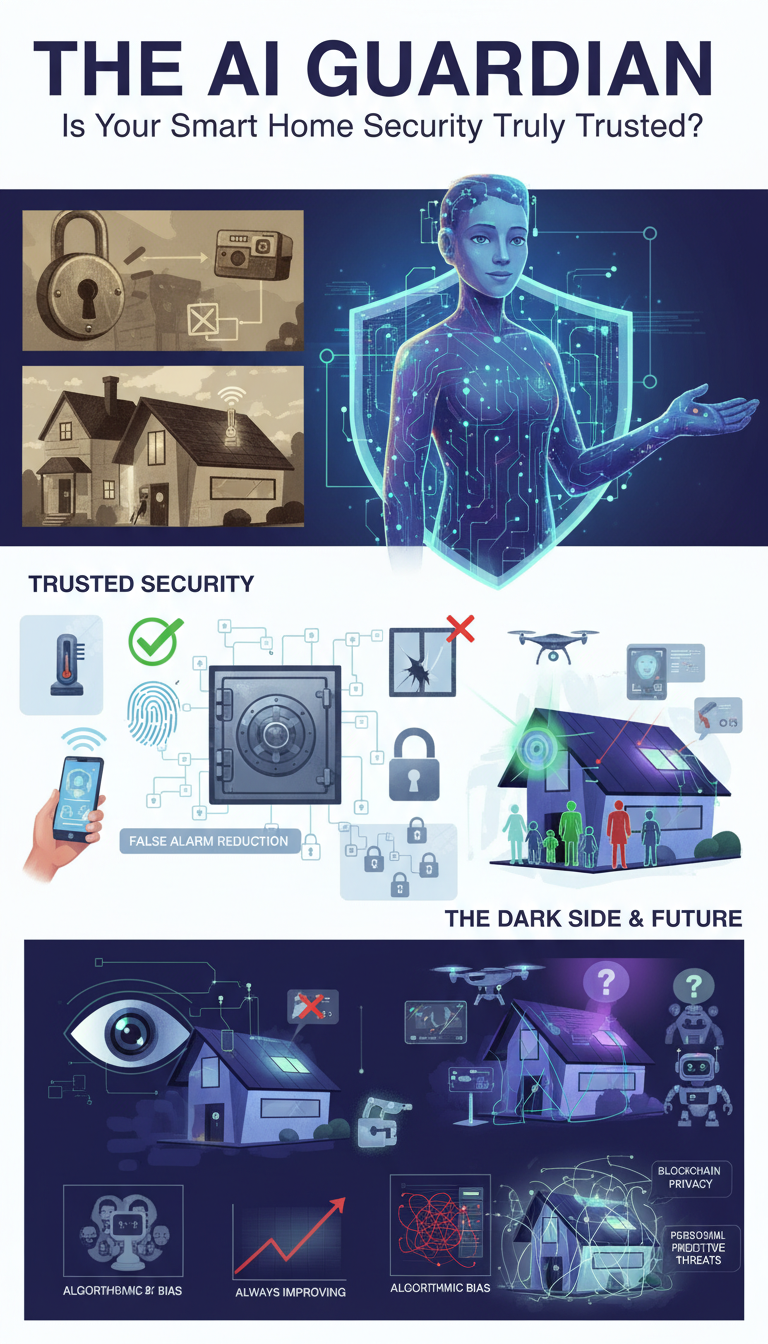
1. Home Security: Then vs. Now
Ah, home security. The very phrase evokes images of simpler times, doesn’t it? I find myself transported back to the 19th century, a world of rudimentary mechanical locks and the nascent stirrings of electrical alarm systems, perhaps something akin to Augustus R. Pope’s inventions. A far cry, indeed, from our present reality. We then saw the gradual march of progress – CCTV cameras appearing in the 70s, offering a grainy, watchful eye, followed by the introduction of microprocessors in the 80s. Each step made things incrementally fancier, didn’t it?
But now? The 21st century has ushered in the Internet of Things (IoT) revolution. Suddenly, our smartphones become the keys to our kingdoms, controlling everything from the thermostat to the front door lock. But I can’t help but wonder if this “smart” convenience has truly made us more secure, or simply more vulnerable in new and unexpected ways.
2. What Makes a Smart Security System “Trusted”?
I would argue that trust, in this context, extends far beyond simply deterring intruders. It encompasses a sense of peace of mind, a feeling that your sanctuary is truly protected and your personal information is safe.
Therefore, rock-solid reliability is paramount. A “trusted” system must function even when the power grid fails, necessitating robust backup systems. Then there’s the matter of data. I contend that end-to-end encryption is non-negotiable, as are options for local storage, placing you, the homeowner, firmly in control of your data.
And let’s not forget the bane of traditional alarm systems: false alarms. A trusted AI Guardian should significantly reduce these annoyances, distinguishing between pets and genuine threats with remarkable accuracy. Transparency is also key. I want companies to be forthright about the capabilities and limitations of their systems.
Finally, a truly trusted system should play well with others. Seamless integration with other smart home devices, like lights and thermostats, creates a unified and responsive security ecosystem.
3. The Brains Behind the Brawn: How AI Elevates Security
The integration of Artificial Intelligence (AI) is not merely a marketing gimmick; it represents a fundamental shift in how we approach home security.
AI algorithms function as super-smart detectives, capable of identifying faces, objects, and suspicious movements in real-time. This goes far beyond the capabilities of simple motion sensors. Furthermore, these systems can learn your habits, establishing a baseline of normalcy and quickly identifying anomalies, such as a door opening when the house should be empty.
Facial recognition technology enables personalized protection, distinguishing between family members and strangers. AI can also automate actions, linking cameras to locks, lights, and alarms to create instant responses to perceived threats. Voice control offers another layer of convenience, enabling users to easily arm, disarm, and check security feeds. And, crucially, these systems are designed to continuously learn and improve over time, becoming more effective the longer you use them.
4. The Dark Side of Smart: Controversies and Concerns
However, I must inject a note of caution into this seemingly utopian vision. Is all this “smart” technology coming at a cost?
The privacy implications are significant. Are we unwittingly inviting “Big Brother” into our homes? Who is watching, and what are they doing with the data collected? The recent fines levied against companies like Amazon for Alexa and Ring practices highlight the very real dangers.
Cybersecurity risks are another major concern. A smart home security system can become a target for hackers, potentially granting them access to your entire network. Algorithmic bias represents another potential pitfall. If AI algorithms are trained on biased data, they may unfairly flag individuals or neighborhoods, leading to discriminatory outcomes.
Moreover, the technology is not without its practical limitations. High costs, reliance on a stable internet connection, and persistent false positives (with misinterpretations still occurring in 20-45% of cases) remain challenges. Finally, we must grapple with the ethical complexities surrounding transparency, user control, and accountability. Who is ultimately responsible when an AI security system makes a mistake?
5. What Does the Future Hold for Your Smart Home Fortress?
Looking ahead, I envision a future where home security increasingly resembles something straight out of science fiction.
Next-generation AI will be capable of even more sophisticated surveillance, spotting package deliveries, analyzing environmental data, and even predicting potential threats before they materialize. “Edge computing,” which processes data locally, will become more prevalent, enabling faster and more private threat detection.
Passwords may become a thing of the past, replaced by biometric authentication methods like fingerprints, facial recognition, and voice analysis. Total integration with every smart device in the home will create a unified and comprehensive defense system. Blockchain technology could offer a decentralized and secure way to protect your data from hacking. And, perhaps most strikingly, we may even see the deployment of autonomous drones and robots to patrol our properties.
6. The Bottom Line: Can You Truly Trust Your AI Guardian?
In conclusion, the rise of the AI Guardian presents both incredible opportunities and significant challenges. I have outlined the potential benefits, from enhanced threat detection to automated responses, alongside the serious issues of privacy, security, and algorithmic bias.
When considering a smart home security system, I urge you to prioritize robust privacy measures, strong security protocols, transparency in data handling, and a commitment to continuous improvement. Ultimately, the question of trust hinges on finding the right balance between innovation for safety and the safeguarding of personal freedoms. As we move forward, I believe that ongoing dialogue and careful consideration will be essential to ensuring that our AI Guardians truly serve and protect us.


Related Posts
This Month’s Best‑Selling Smart Home Security Products – December 2025
Delivers Full-Range Sound with Exceptionally Loud Distortion with Maximum Output and Compact Design
A Comprehensive Guide to Web Application Firewalls (WAFs)